

Me, Myself, and Another Self
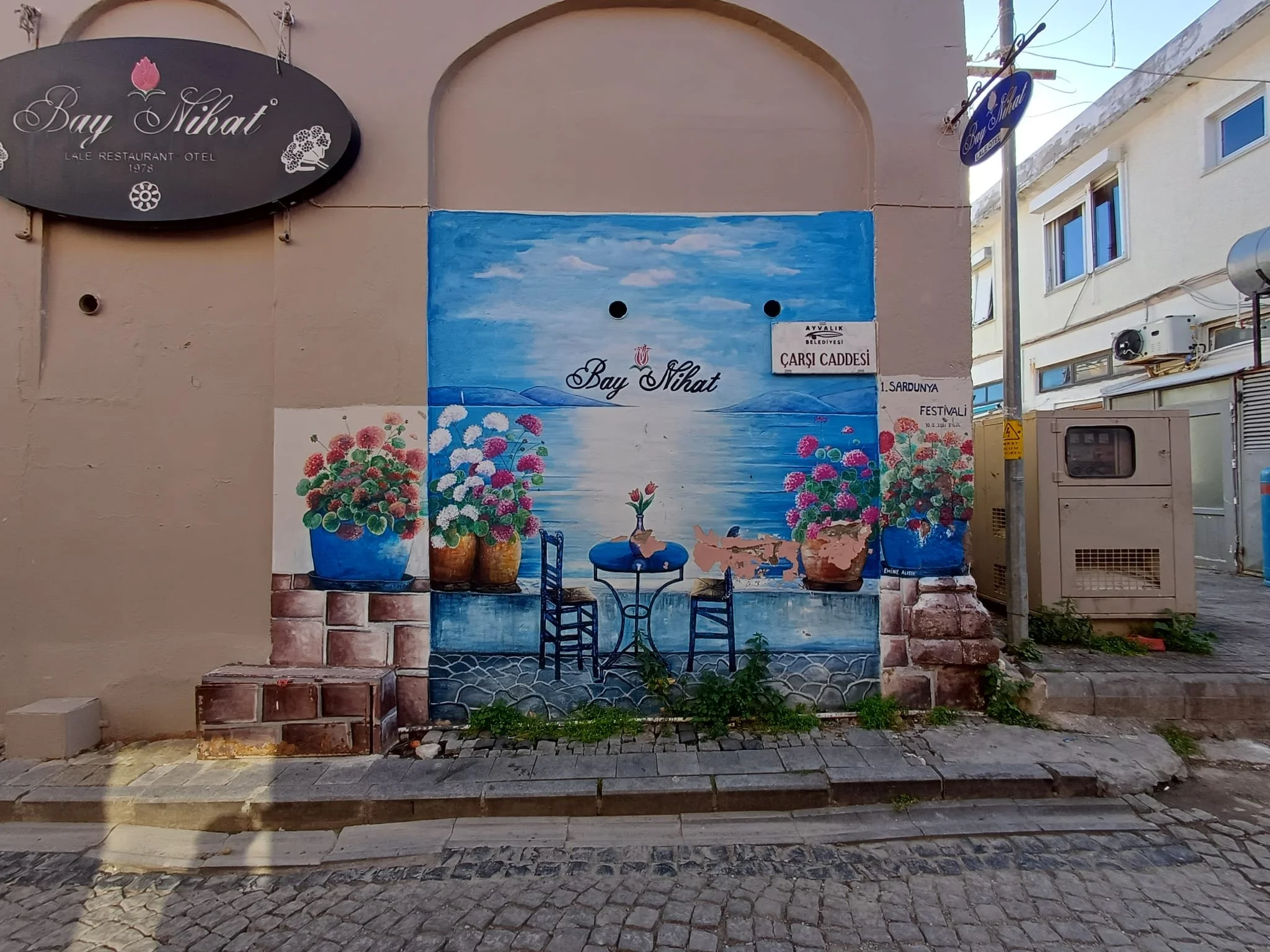
@ Cunha Island
After my time in Istanbul, I decided to travel along the Aegean coast of Turkey to explore more of the country’s coastal beauty. One place that quickly stood out: Ayvalık. Why? Because this is where many scenes of the Netflix series Another Self (original Zeytin Ağacı)were filmed. But this series is not just about friendship or a journey to a beautiful coastal town. It is about transgenerational trauma— the invisible threads that run through families, shaping who we become, how we love, and what we believe we deserve. Experiences such as loss, displacement, emotional neglect, or silence do not simply disappear; they are often carried forward, expressed in behaviors, relationship patterns, and even in the way emotions are regulated across generations.
It is about ancestral healing—the process of becoming aware of these inherited patterns and gently turning towards what has long been avoided, suppressed, or never spoken about. This kind of healing is not linear; it asks for courage, presence, and a willingness to feel what previous generations could not. And at its core, it explores what could be described as healing along the maternal line: how the lived experiences of mothers, grandmothers, and great-grandmothers—shaped by their historical, cultural, and social realities—can echo in the emotional worlds of the women who come after them. These influences may appear in subtle ways: in attachment styles, in self-worth, in the kinds of relationships we choose, or in the roles we unconsciously take on.
Through a form of therapeutic work resembling psychodrama and family constellation, 3 women begin to uncover how their childhood experiences—and the unresolved pain of those before them—still manifest in their adult lives.

There is Leila, vibrant and full of life on the surface, yet carrying a deep wound of never feeling enough. As she traces her lineage, she encounters the story of her Greek grandmother, marked by displacement and loss. That unprocessed grief echoes through her mother, and ultimately into Leila’s own sense of worth and belonging. Her relationship with Erdem—himself shaped by early loss and emotional absence—becomes a mirror of these inherited patterns.
Then there is Sevgi, a successful lawyer facing cancer. Her illness becomes more than physical—it opens a doorway. Her journey is one of surrender, of finally allowing herself to feel, to soften, and to seek healing not only for her body, but for her emotional and ancestral wounds.
And Ada—my personal favorite. A doctor grounded in logic, control, and the safety of the rational mind. She initially resists the process, skeptical of anything that cannot be explained. But as she slowly lets go, she begins to see the connection between her childhood emotional neglect and the relationships she has chosen—men who could never fully meet her, who remained distant or unfaithful, mirroring the love she learned to expect.
What unfolds is not a simple narrative, but a layered exploration of how trauma travels across generations—and how, with awareness, it can begin to dissolve. Watching this series did not feel distant or abstract to me. It felt familiar—almost uncomfortably so.
I recognized myself in the patterns the women were uncovering: the quiet feeling of not being fully chosen, the subtle belief of not being enough, and the tendency to be drawn, sometimes, to people, especially in dating, who remain somehow distant.
Looking back, I can see how this has shown up in my own life. In relationships that lacked emotional availability. In moments where I accepted less than what I actually needed. Even recently, I found myself stepping into a dynamic that felt familiar—this time, I recognized it earlier and stepped away. Still, it left me wondering: how much of this is truly “mine”?
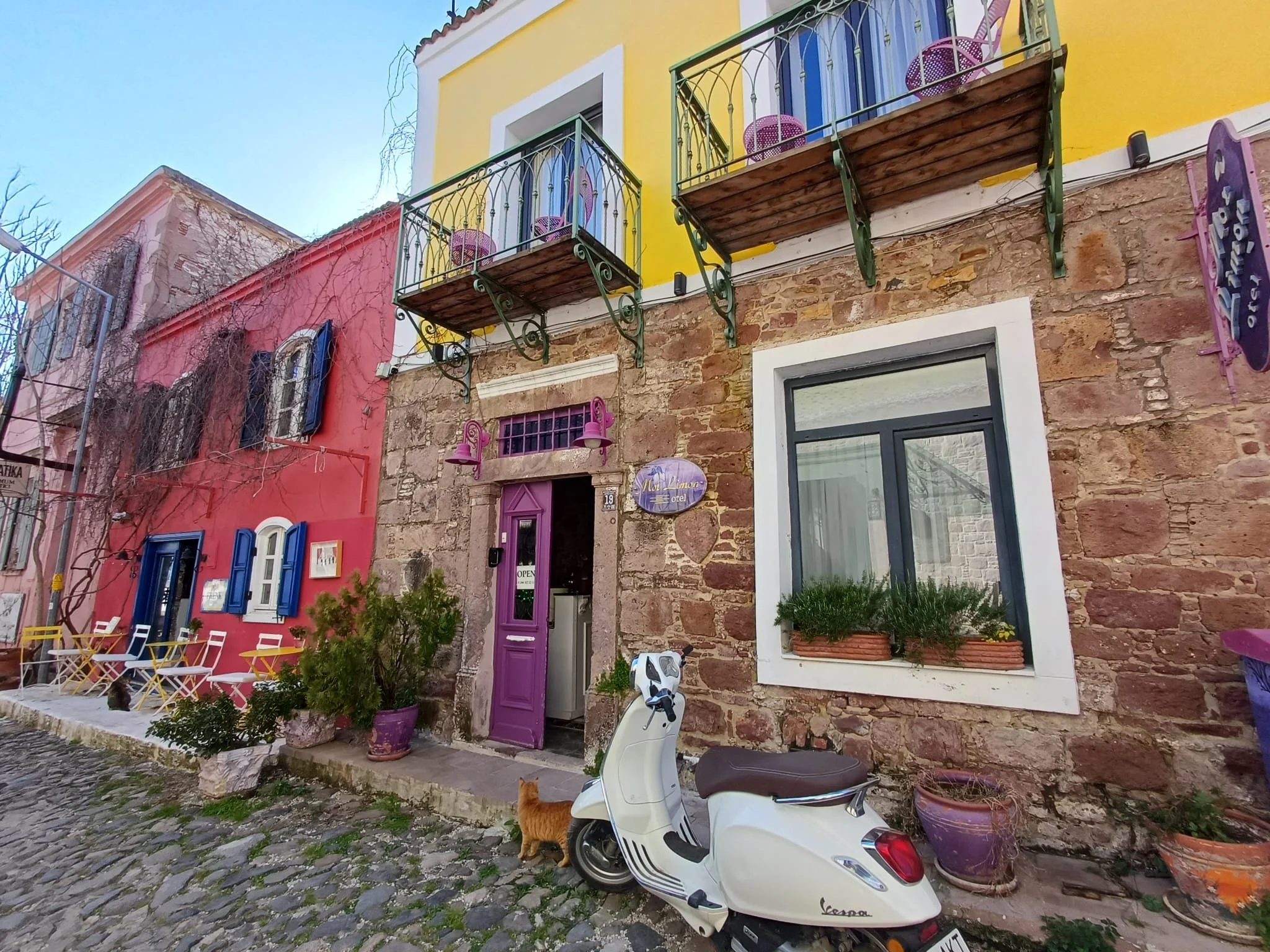
As I walked through Ayvalık and Cunha Island, past old stone houses and narrow streets opening towards the sea, I noticed how present everything felt—the light, the wind, the quiet rhythm of the water. There is something about coastal places that invites reflection. Maybe it is the horizon. Maybe it is the constant movement of the waves. Or maybe it is the way the sea seems to hold memory without holding on.
Because when I look at my family, I see a lineage marked by loss. A grandmother I never had the chance to know. A mother who grew up without her own mother. A grandfather shaped by the weight of war. Experiences that were never fully processed, never fully spoken about—but that did not simply disappear.
Instead, they seem to echo—quietly—through generations. Not as something to blame. But as something to understand.
Books like “Das Kind in dir muss Heimat finden” helped me begin to put words to these inner dynamics—to understand how early emotional experiences shape our sense of self, our boundaries, and the relationships we choose later in life. However, there is something still unresolved inside me and I keep asking myself:
Is my nervous system unconsciously drawn to familiar patterns—perhaps even those shaped long before me—in an attempt to resolve what was never fully processed?
And maybe this is where healing begins—not in fixing everything at once, but in becoming aware. In recognizing what we carry. And in slowly, gently, choosing differently.
(This part will be updated as more experiences unfold.)
From a scientific perspective, there is growing evidence that experiences—especially stress and trauma—can leave biological traces that extend beyond a single lifetime. Research in epigenetics shows that environmental factors can influence gene expression without altering the DNA sequence, for example through mechanisms such as DNA methylation or histone modification. Some studies suggest that these epigenetic changes may, under certain conditions, be transmitted across generations. For instance, Yehuda et al. (2016) found altered stress-related epigenetic markers (e.g., in the FKBP5 gene) in both Holocaust survivors and their offspring. Similarly, animal studies demonstrate that parental stress can influence stress reactivity and behavior in subsequent generations (Dias & Ressler, 2014).
However, it is important to note that the idea of “inheriting a nervous system” is not literal. What is transmitted is better understood as a combination of biological sensitivity and learned patterns. Early-life environments—shaped by caregivers who themselves carry unresolved stress—play a central role in the development of the child’s stress response system, including the HPA axis. This means that intergenerational transmission occurs through both biological pathways and relational dynamics such as attachment, emotional regulation, and modeled behavior (Meaney, 2001; Bowers & Yehuda, 2016).
In this sense, what we often experience as deeply personal patterns—how safe we feel, how we relate to others, how we respond to stress—may partly reflect adaptations shaped not only by our own experiences, but also by those who came before us.
Sitting by the water, I found myself thinking about everything the series had brought up. About patterns. About inheritance. About the subtle ways the past can live in the present—not only in stories, but in the body, in relationships, in emotional responses that feel older than we are.
And at the same time, the sea offered a different perspective: movement instead of stagnation. Change instead of fixation.
Perhaps healing is not about erasing what has been, but about allowing it to move.
Nothing in nature is ever truly static. Waves shift. Tides turn. Water finds new paths. And maybe we can too.
References:
