

In an earlier article, I explored the idea of the female line: what might travel from mothers to daughters, from grandmothers to mothers, through biology, relationships, stories and patterns that may persist long after we have forgotten where they began.
But families are not made from one line alone. Lately, I have found myself thinking about the other side of that story.
What do fathers leave their daughters?
Not only genetically. Not only through the obvious things we can name — our appearance, certain gestures, perhaps the shape of our hands or the way we laugh.
What stays inside us after years of being someone’s daughter? Which parts of a father become part of the way we think, love, explore, choose, trust and move through the world?
As an only child who shared a close relationship with my father, I find myself returning to this question. And perhaps the image that makes most sense to me is not a family tree at all. It is a house.
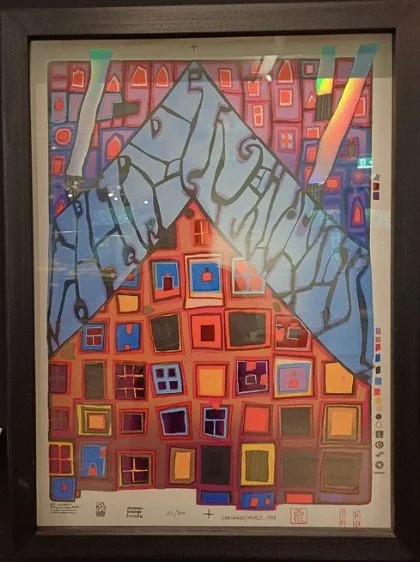
The people who build our inner house
When I look at this Hundertwasser image (Hundertwasser Museum Vienna), I think about the idea of an inner house: the psychological space we slowly build within ourselves from experiences, relationships, memories and everything we learn about what the world is like.
Some people visit that house. Some occupy a room for a while. And some become part of its architecture.
My father resembles many parts of my inner house.
One of them is curiosity.
He was interested in almost everything. He liked exploring whatever was possible, searching beyond the obvious, not settling for superficial answers and looking for better alternatives when the conventional one did not make sense.
In that respect, we are remarkably alike. He was an eternal student. He read books, remained curious, kept learning and kept an open mind.
And that openness extended beyond ideas to people. Different countries, different cultures and different kinds of people were something to be interested in rather than frightened of. Making sure that nobody was excluded mattered.
I recognise a lot of myself in that.
The scientist who keeps asking another question. The person who has lived in different countries and remains endlessly fascinated by people. The tendency to dig underneath a subject rather than being satisfied with the first answer.
Even Oceans & Emotions probably contains more of that inheritance than I realised when I started it - Maybe inheritance sometimes looks less like receiving something and more like continuing a way of looking at the world.
Learning to dive deep
He also taught me something else: to dive deep. And I do not only mean underwater. I mean relationships too.
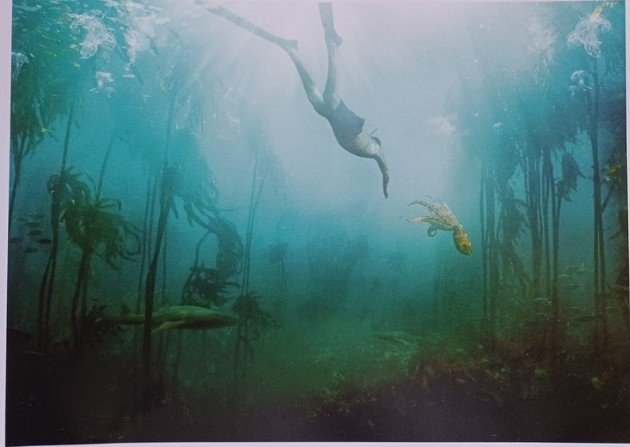
Friendships, partners, family, colleagues — I learned that sincerity matters. That a few profound relationships can be more valuable than many superficial ones. That reliability matters. That the people around us matter. That there is value in building something stable rather than constantly moving across the surface.
Interestingly, psychological research gives some language to this intuition.
For a long time, developmental research concentrated much more heavily on mothers. Research on fathers expanded considerably later.
Today, father–child relationships are understood as one important part of the relational environment in which children develop. Warm, responsive and involved father–daughter relationships have been associated with psychological adjustment, self-esteem, social functioning and well-being.
Image: Craig Foster, My Octopus Teacher. Book Oceans.
A 2018 study by Sağkal, Özdemir and Koruklu examined 310 adolescent girls in Turkey. Rather than looking simply at whether a father was physically present, the researchers examined the quality of the father–daughter relationship, including closeness and time spent together.
Girls who reported stronger father–daughter relationships also reported greater psychological well-being and lower psychological distress.
The study was cross-sectional, so it cannot establish that the father–daughter relationship itself caused those outcomes. But what I find particularly interesting is the pathway the researchers explored. They looked at 3 basic psychological needs:
autonomy — experiencing ourselves as capable of making our own choices;
competence — feeling able to act effectively in the world;
and relatedness — experiencing genuine, caring relationships with other people.
A stronger father–daughter relationship was associated with greater satisfaction of these needs, which in turn was associated with greater well-being and lower psychological distress.
Being able to stand on your own. Believing that you can do things. And knowing how it feels to be genuinely connected to another person.
Perhaps those are some of the beams and walls from which an inner house is made.
However, there is an important distinction:
influence is not destiny.
Scientific research likewise points to associations between father–daughter relationship quality and later outcomes such as self-esteem, partner attachment and relationship satisfaction. These are patterns, not formulas.
We are not psychological photocopies of our parents. But they can provide some of our earliest reference points.
What does reliability feel like? What does respect sound like? Can disagreement happen without destroying the relationship? Can independence and connection coexist?
Long before we can consciously formulate questions like these, we are already experiencing possible answers.
Music has its own kind of inheritance
Some things pass between generations in much simpler ways. Music, for example.
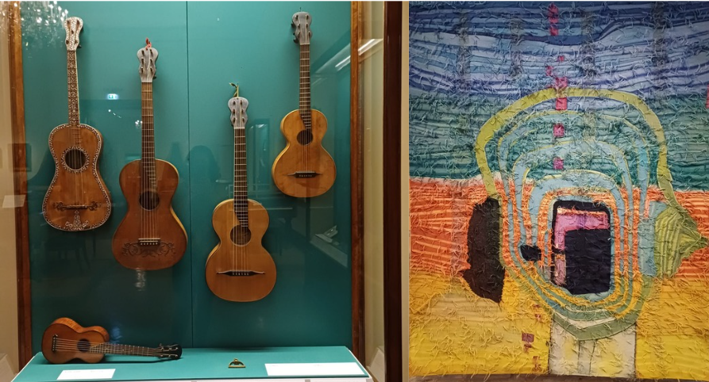
Recently I walked through the Weltmuseum Vienna and found an awesome collection of all kinds of instruments.
My father loved music. He played guitar — with me, with my grandfather, with friends and sometimes even with people he had only just met.
Then I continued to Hundertwasser Museum, and saw this beautiful textile image: it reminded me of him, listening to music through his large headphones.
That is probably why this artwork immediately reminded me of him. I am not currently playing guitar. I play the djembe instead. Different instrument, same impulse.
There is something beautiful about recognising that continuity without having planned it. We do not necessarily inherit the exact activity. Sometimes we inherit the orientation toward it. Perhaps that is true of many things parents give us. The instrument changes. The melody continues.
An open door to the world
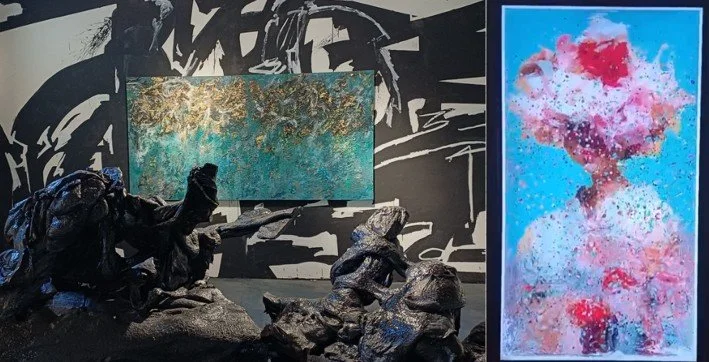
Left image: Tarhan Han, Istanbul. Right image: Villa del Arte, Istanbul.
My life has taken me to places and fields:
Marine biology. Chemistry. Diving. Different countries. Art. Dancing. Psychology. Music. Teaching. Oceans.
But perhaps they are connected by something much simpler. Curiosity. An open door.
I grew up with the idea that there was always something else to learn, somewhere else to explore, someone different worth talking to. That openness is one of the clearest things I recognise as coming from my father.
And I think I continued that. But not everything I became came directly from him. Some parts I developed mostly myself.
One of them is what I would call emotional expansion: becoming increasingly willing to feel more. Allowing joy, grief, tenderness, longing, vulnerability and connection to occupy more space rather than keeping emotional life neatly contained.
And alongside that came something slightly different: emotional integration.
For me, emotional integration means not treating feelings as separate from thought, science, the body or the way we live. It means allowing emotions to become information — not unquestioned truth, but something worth listening to. It also means becoming more able to hold seemingly contradictory experiences at the same time:
love and frustration; independence and attachment; sadness and gratitude; strength and softness.
Emotional expression was not always my father’s strongest language. That part was less something he explicitly taught me and more something I developed along my own path. And perhaps this is another important part of growing up:
Inheritance is not the same as replication. We receive a structure, but we keep building. Maybe he gave me the curiosity to keep opening doors. I used some of those doors to enter places he himself did not necessarily go.
In that sense, my inner house is not a copy of his. Some rooms resemble him very strongly. Some I have renovated. Others I built myself.
And some may only exist because what I inherited from him — curiosity, openness and the urge to go deeper — eventually led me there.
Parents influence us enormously. But they do not finish us.
Research can describe patterns in father–daughter relationships, but development continues through later relationships, experiences, culture, education, travel, therapy, loss and our own conscious choices.
Perhaps that is the more interesting idea:
we inherit foundations, and then we renovate.
And then there is the ocean
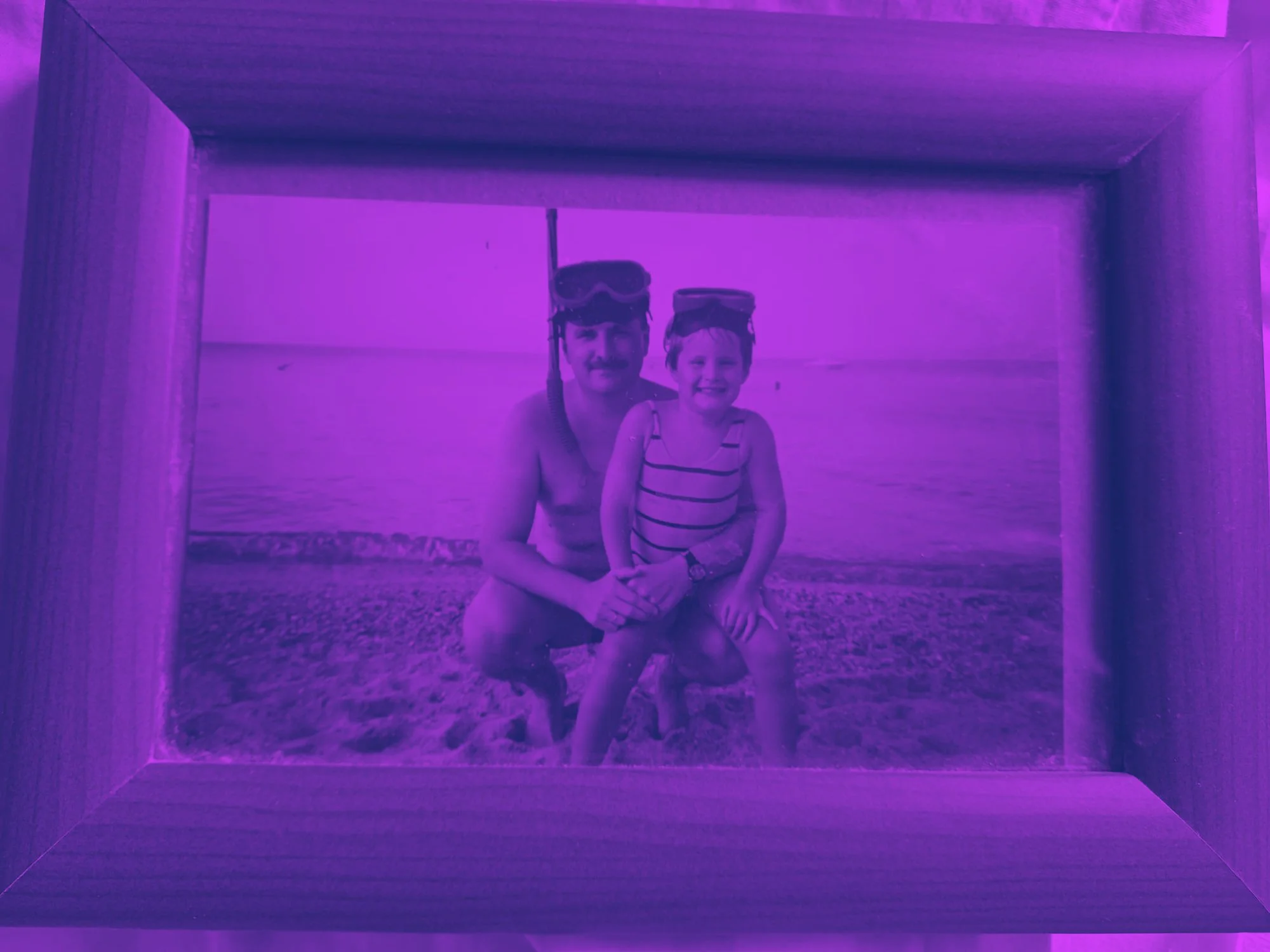
Some of my memories with my father are connected to water. And perhaps that is why the metaphor of diving deep never feels completely metaphorical to me.
There is something particular about sharing the underwater world with another person. Conversation becomes impossible. Everything familiar is temporarily rearranged. You communicate through gestures, proximity and attention. You look at something together.
And years later, what remains may not be a detailed chronology of the day. It may simply be the feeling of having explored something side by side.
That is one of the things I increasingly find fascinating about memory. People remain with us not only as stories about the past, but through the way we continue to perceive the present.
A building. A pair of headphones. A guitar. A strange piece of art.
The sea. And suddenly, another person is there. Not literally. But unmistakably. What fathers leave their daughters.
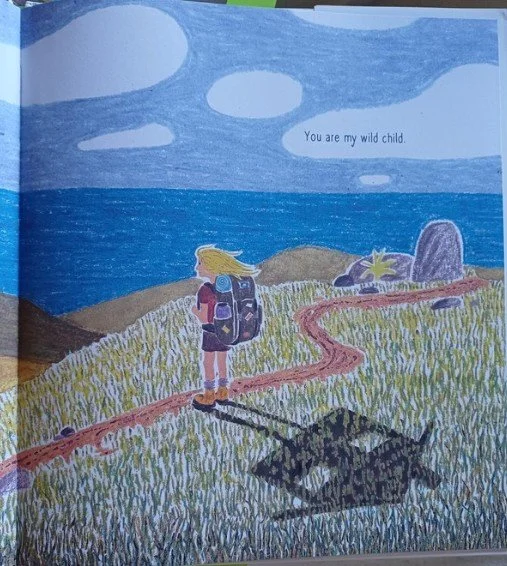
Dear Wild Child
While thinking about fathers, daughters and oceans, I inevitably returned to another marine conservationist whose work I have wanted to write about for some time:
Wallace J. Nichols. And his beautiful book Dear Wild Child.
Nichols wrote it together with his daughter, Wallace Grayce Nichols.
And that makes it a particularly beautiful place to end this reflection: not only with a theory about what fathers give daughters, but with an actual conversation between a father and his daughter.
A father. A daughter. And the natural world around them. Perhaps what we leave other people is never one single lesson. Perhaps it is an invitation:
Stay curious. Go deeper. Pay attention. And keep exploring. Carry your home with you.
Image: last page of bookDear Wild Child. You Carry Your Home Inside You.
And as for what the ocean itself might have to do with all of this — with memory, connection, emotion and the strange calm that can appear when we are close to water?
That takes us somewhere else. Into the Blue Mind. But that deserves its own dive.
References:
Sağkal, A. S., Özdemir, Y., & Koruklu, N. (2018). Direct and indirect effects of father-daughter relationship on adolescent girls’ psychological outcomes: The role of basic psychological need satisfaction. Journal of Adolescence, 68, 32–39. https://doi.org/10.1016/j.adolescence.2018.07.001
Kromberg, J. (2013, July 1). How dads shape daughters’ relationships.
Psychology Today. How Dads Shape Daughters’ Relationships
Buddhist Psychotherapy. (n.d.). Father-daughter relationships: Why they matter & how to build a strong bond. Retrieved September 5, 2026, from Buddhist Psychotherapy
Nichols, W. J., & Nichols, W. G. (2022). Dear wild child: You carry your home inside you. Cameron Kids.
Nichols, W. J. (2014). Blue mind: The surprising science that shows how being near, in, on, or under water can make you happier, healthier, more connected, and better at what you do. Little, Brown and Company.
